Please read these instructions carefully. Manuscripts that do not follow them will be returned before peer review. JMCHS follows the ICMJE Recommendations for the Conduct, Reporting, Editing, and Publication of Scholarly Work in Medical Journals.
1. Before you submit
• Check that your work fits the Aims & Scope, including its relevance to South Asia or comparable settings.
• The manuscript must be original, not previously published (except as a preprint or thesis) and not under consideration elsewhere.
• All authors must have approved the submission and meet the authorship criteria.
• Ethics approval, informed consent and trial registration (where applicable) must be in place.
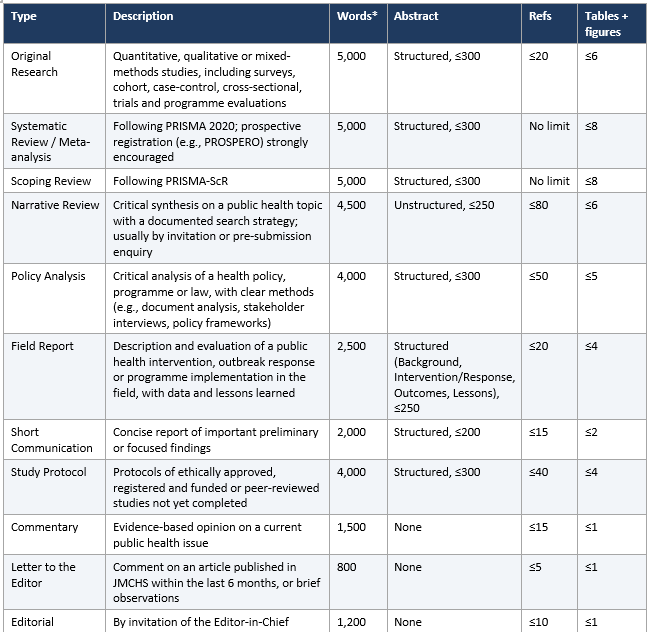
*Word counts exclude title page, abstract, references, tables, figure legends and declarations. Editors may allow longer manuscripts when justified.
3. Title page
• Full title (concise, informative; include study design where appropriate, e.g., ‘…: a community-based cross-sectional study’); short running title (≤50 characters).
• All authors’ full names, highest degrees, departments, institutions, cities, countries, email addresses and ORCID iDs (mandatory for the corresponding author).
• Corresponding author’s full postal address and email.
• Word count, number of tables and figures.
• Declarations (see section 7).
4. Manuscript structure
Original Research (IMRaD)
• Title
• Structured abstract (≤300 words): Background, Objectives, Methods, Results, Conclusions. Include the trial registration number for trials.
• Keywords: 4–6, preferably from Medical Subject Headings (MeSH).
• Introduction: context, knowledge gap and objectives.
• Methods: study design, setting (country, state/province, district, urban/rural) and dates, participants and sampling, sample size calculation, variables and definitions, data collection tools (with validation), data management, statistical or qualitative analysis, and ethics statement (committee name blinded for review). Report sex and gender following SAGER.
• Results: follow the reporting guideline; give absolute numbers with percentages, and effect estimates with 95% confidence intervals.
• Discussion: key findings, comparison with other studies (especially from the region), strengths and limitations, implications for policy and practice.
• Conclusions: supported by the data, without overstatement.
• Key messages box (optional but encouraged): 2–3 bullet points each for ‘What is already known’ and ‘What this study adds’.
• References
5. Style and formatting
• English (British or American, used consistently). Authors whose first language is not English may wish to use language editing before submission; this does not affect editorial decisions.
• Microsoft Word or compatible format, 12-point font, double spacing, line and page numbers.
• SI units; local units (e.g., lakh, crore) should be converted or explained. Currency should be given in local currency with USD equivalent and the year.
• Abbreviations defined at first use in the abstract and again in the main text.
• Use inclusive, non-stigmatising language (e.g., ‘people living with HIV’, ‘people who use drugs’). Describe caste, religion or ethnicity only when relevant to the research question, with justification.
• Name drugs by generic (non-proprietary) names.
References
Use the Vancouver (ICMJE/NLM) style, numbered consecutively in the order cited, with numbers in square brackets or superscript. Include DOIs where available. Cite government reports and survey data with URL and access date. Unpublished data and personal communications are cited in the text only. Authors are responsible for the accuracy of all references; references that cannot be verified will be queried.
Format example (illustrative only): Kumar S, Rao P, Das A. Prevalence of anaemia among adolescent girls in rural Odisha: a cross-sectional study. J Med Community Health Sci South Asia. 2026;1:e001. doi:10.xxxxx/jmchs.2026.001
Tables and figures
Tables must be editable (not images), with a title above and footnotes defining abbreviations. Figures must have legends and be understandable on their own. Maps must use internationally recognised boundaries or include a disclaimer that the boundaries shown do not imply any opinion on legal status. Photographs of people require consent (see Participant Privacy).
Authors must disclose conflicts of interest, funding sources, and ethical approvals (IRB/ethics committee) where applicable.